Macau from Hong Kong
Four hundred years of Portugal on the Chinese coast, an hour from Hong Kong by sea or forty minutes by the world’s longest sea bridge. The old town is the trip; the casinos are the skyline it happens under.
The short version
- The classic crossing: frequent ferries from Sheung Wan’s terminal to Macau’s Outer Harbour in about an hour. The newer one: 24-hour shuttle buses across the Hong Kong–Zhuhai–Macau Bridge in about 40 minutes port to port, cheaper and immune to sea state.
- Macau runs its own immigration — passport required both directions, stamps or e-channels depending on your documents — and the pataca circulates alongside Hong Kong dollars accepted at par nearly everywhere.
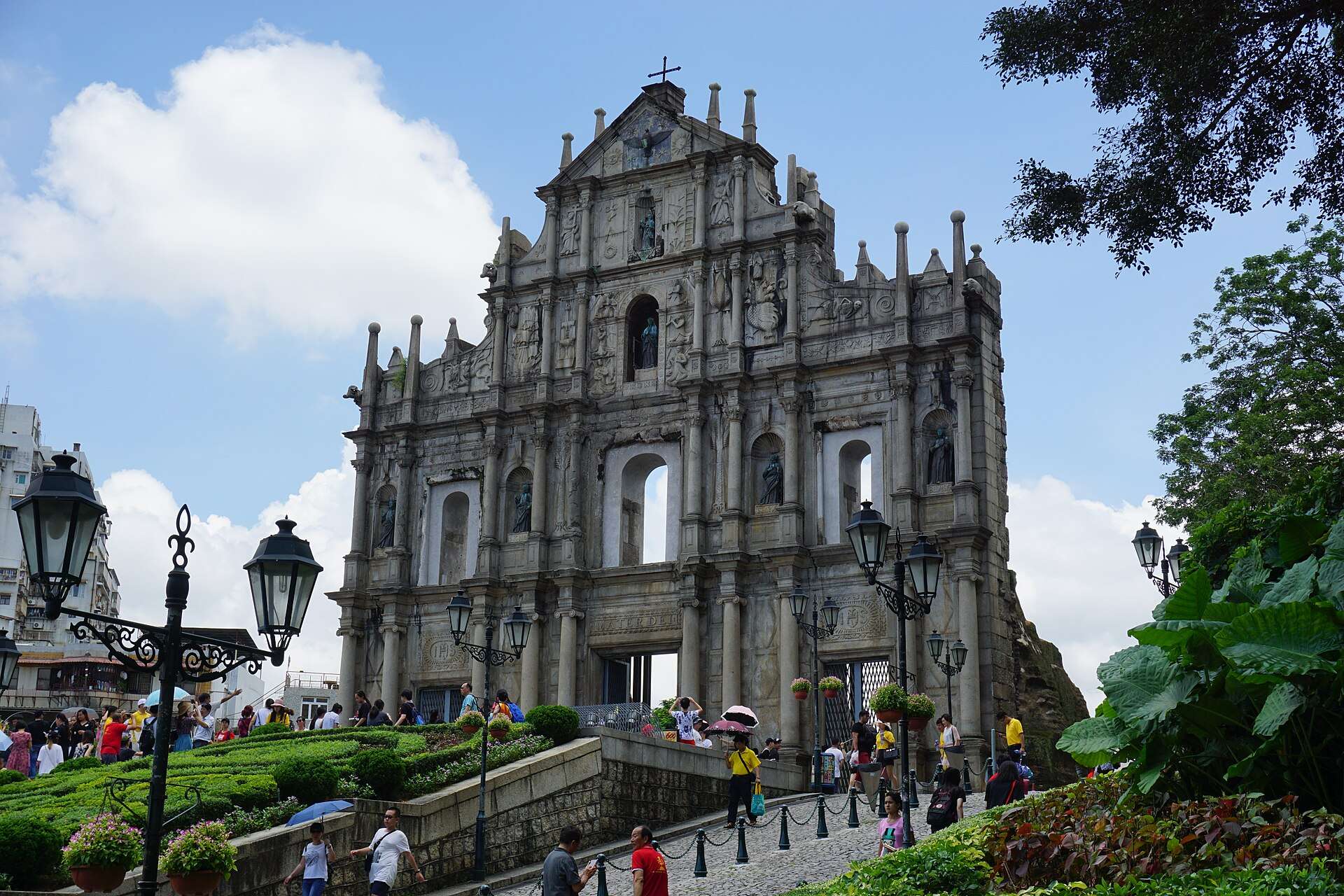
- The Ruins of St. Paul’s — the carved stone facade standing alone above its staircase after the 1835 fire took the church — is the territory’s emblem and the historic center’s summit.
- The UNESCO-listed center strings Senado Square’s wave-patterned paving, St. Dominic’s yellow baroque, the Leal Senado, and lanes where street signs run Portuguese-first four centuries on.
- A-Ma Temple, the harbor shrine that predates the Portuguese and possibly named the territory, anchors the old town’s far end past the Moorish Barracks.
- Taipa Village’s pastel lanes handle the second act — Portuguese kitchens, almond-cookie arms races, and the egg-tart institutions whose queues self-identify; the Cotai casino strip looms beside it as its own optional planet.
Getting there
Choose by temperament: the ferry’s hour reads as a small voyage with harbor theater at both ends; the bridge bus wins on cost, frequency, and typhoon-season reliability, with the 55-kilometer crossing’s sea-tunnel dips as its own oddity. Both funnel through full border formalities — the passport line at peak weekends is the real travel time. Within Macau, buses and cheap taxis cover the peninsula-to-Taipa hops; the old town itself walks entirely.
The day
Land and head for the center: Senado Square’s paving before the tour groups pattern it themselves, St. Dominic’s, and the climb through the shopping lanes to St. Paul’s facade — take the staircase’s classic angle, then the side stairs up behind the stonework for the view back over the town. The fortress and museum beside it add the cannon-line panorama. Wander toward A-Ma Temple through streets where bacalhau and dim sum share blocks, then cross to Taipa for the late afternoon: the village lanes, a serradura or the egg tart you saved per the alarm, and Portuguese dinner if the timetable allows — minchi and African chicken are the fusion the territory invented. The casinos receive whoever wants receiving; the last buses and ferries run late enough to make that a genuine choice rather than a schedule.
When to go
October through March delivers the walking weather the cobbles want; April warms and summer runs humid with typhoon-season ferry drama the bridge buses ignore. Chinese holiday weeks — Golden Weeks above all — pack the crossings and the square shoulder to shoulder; ordinary weekdays halve everything. The Macau Grand Prix in November converts streets to racetrack with its own crowd math. Evening changes the territory’s costume: the facade floodlit, the casino skyline switched on — staying past dusk before a late crossing is the two-for-one version.
Frequently Asked Questions
Ferry or bridge bus?
Bridge for cost, frequency, and weather immunity; ferry for the classic approach and Sheung Wan convenience. The connoisseur’s answer is one of each — ferry over, bridge back after dark.
Do I really need my passport?
Yes — Macau is a separate immigration territory from Hong Kong, full stop. The crossing without it ends at the first counter, both directions.
Is Macau just casinos?
The casinos fund the skyline; the old town predates them by centuries and needs nothing from them. A visitor can spend the full day in the UNESCO center and Taipa without seeing a gaming floor — this page’s version does exactly that.
What must I eat?
The pastéis de nata at the famous bakeries (the queue is the signage), pork-chop buns, almond cookies from the pressing shops, and — for the sit-down meal — Macanese classics like minchi or African chicken, the world’s first fusion cuisine defending its title.
Can I combine Macau with anything?
It is its own full day; the border formalities bracket it firmly. The one legitimate extension is temporal — staying into the evening for the lights before a late bus home.